KALO
KALO provides metering, analysis and billing services for the real estate and housing industry. Their offerings include infrastructure for consumption data collection, maintenance of ventilation systems and integrated billing of heating and operating costs, aiming to help clients reduce expenses.
My role centers on finding the most effective way to translate KALO’s requirements and layouts into a maintainable, scalable TYPO3 setup. This involves aligning technical feasibility with design intent, discussing options with project managers and clients and ensuring that both the frontend and CMS interface remain intuitive for long-term editing and growth.
Fields
UX Design, Development Briefing, Testing
Team
AHOII Networking

01
Website Relaunch
Background and Challenge
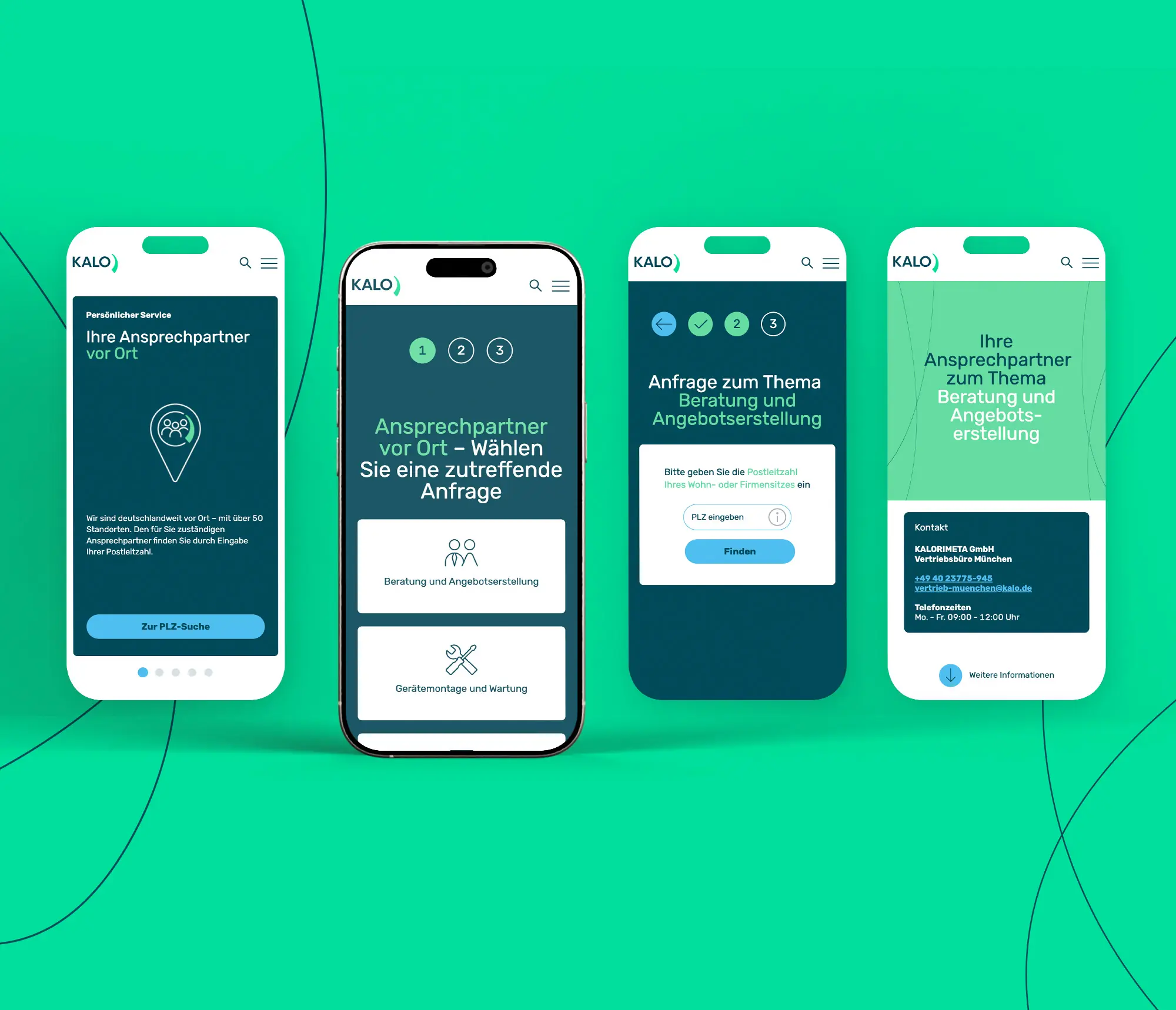
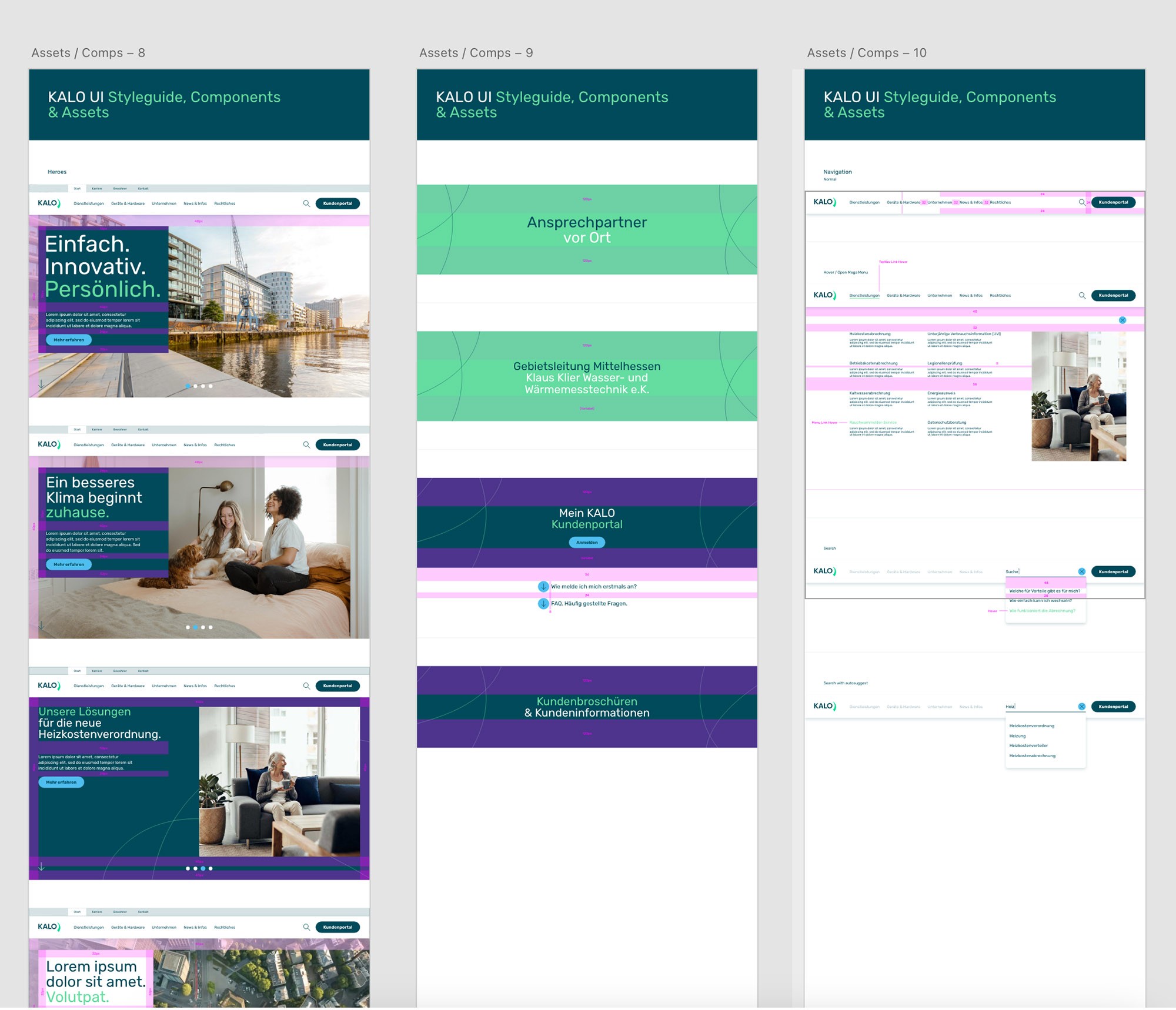
For the website relaunch, KALO provided designs created by an external design agency, with the task of implementing them into TYPO3. The challenge lay in translating highly detailed, sometimes very specific layouts into a CMS-driven website that would be edited by many users over time. Not all design elements were equally suitable for direct implementation, especially when considering budget constraints, editorial effort, and long-term maintainability. At the same time, the visual integrity of the designs needed to be preserved as much as possible. Finding the right balance between design accuracy, cost-efficiency, and CMS usability was critical for a sustainable relaunch.
Approach
To address these challenges, we began by analysing the full set of layouts to understand their structure, complexity and reuse potential. This provided the foundation for building a flexible TYPO3 element system that could support both the current relaunch and future content needs. Regular alignment with KALO ensured that technical decisions, simplifications and alternatives were discussed transparently and collaboratively.
Identify recurring patterns across layouts to define reusable content elements
Reduce complexity by consolidating similar modules into flexible components
Evaluate which highly specific elements were essential and which could be simplified
Introduce interim solutions where full implementation was not viable for the relaunch
Develop and discuss alternatives or counterproposals in line with budget and maintenance effort
The result is a modular TYPO3 setup that respects the original design language while enabling efficient content management. Editors benefit from a clear, scalable backend that supports consistent page creation without unnecessary complexity. By combining thoughtful prioritising with transparent decision-making, the relaunch established a maintainable foundation that can evolve alongside KALO’s future requirements.

02
Newsletter
Background and Challenge
KALO wanted to expand their contact forms with an optional newsletter signup. Although simple at first glance, the complexity lay in planning for future scalability: the newsletter system would gradually evolve into multiple topic-specific newsletters for different target audiences. Therefore, the solution needed to support flexible categorisation without requiring development work for each new variation. Another key aspect was optimising the workflow for the CMS administrators rather than website visitors. The goal was to empower admins to independently adjust and reuse contact forms for different scenarios, ensuring easy handling as new newsletter groups are introduced.
Approach
We began by researching suitable third-party tools that offered reliable newsletter management and seamless TYPO3 integration. Brevo was selected for its flexibility and the ability to assign users to different newsletter groups. To prepare for future expansion, we extended the contact form with a hidden field that stores a number corresponding to the desired newsletter group. This allows each instance of the form to override defaults and adapt to any communication need without structural changes.
Select Brevo as an adaptable, CMS-friendly newsletter provider
Extend the generic form with a hidden group-ID field
Allow editors to override default settings when placing the form on a page
Ensure forms can be duplicated and reused for new use cases
Enable step-by-step rollout of multiple newsletter categories
The resulting system gives KALO full flexibility to grow their newsletter strategy without additional development overhead. CMS administrators can now adapt forms, assign newsletter groups and configure variations independently. This scalable setup supports both the current generic newsletter and future expansions into multiple audience-specific formats, creating a sustainable and editor-friendly workflow.